Written by: Travel Editorial Desk (Destination & Transit Research Team)
Reviewed by: Travel Fact-Checking Team (Destination Policy & Logistics Review)
Editorial Standard: Updated Travel Guide | Primary Source Checked — Cross-checked against official transit authorities, municipal portals & consular guidance
Editorial Verification: Schedules, fare structures, and entry rules are cross-checked against official transit operators, municipal portals, and government travel advisories.
BLUF: German noise protection statutes enforce strict quiet hours (Ruhezeit). Core standard: Zimmerlautstärke (room volume, maximum 35 to 40 dB(A) night, 50 dB(A) day inside receiving dwelling). Federal, state, municipal laws mandate absolute rest Sundays and public holidays (00:00 to 24:00) plus nocturnal rest (Nachtruhe, 22:00 to 06:00/07:00). Midday rest (Mittagsruhe, 13:00 to 15:00) binds via local bylaws or building rules (Hausordnung). Violations trigger police dispatch, administrative fines up to €5,000 under OWiG § 117, tenant warnings (Abmahnung), or eviction. Short-term visitors in holiday apartments (Ferienwohnungen) hold identical legal liability as permanent residents.
1. Executive Summary & Direct BLUF Answer: Core Ruhezeit Mandates
German legal tradition treats acoustic insulation and residential silence not as courtesy, but as enforceable civil right. Foreign nationals entering under standard tourism regimes must observe these standards immediately upon occupancy. Travelers entering Germany under the Schengen Borders Code (Regulation EU 2016/399) or processing electronic screening via the Official European Commission ETIAS Portal remain subject to federal and state misdemeanor statutes throughout their stay. Consular processing directives documented in the U.S. Department of State Germany Travel Advisory confirm local law enforcement prosecutes municipal noise code breaches without diplomatic exemptions for foreign tourists.
German quiet hours divide into statutory rest blocks:
- Nachtruhe (Night Rest): Daily 22:00 to 06:00 (extended to 07:00 in specific federal states like Bavaria and residential zones in Hesse). All acoustic output exceeding apartment perimeter forbidden.
- Sonn- und Feiertagsruhe (Sunday and Public Holiday Rest): Statutory full-day acoustic embargo. Runs 00:00 to 24:00 across all 16 federal states (Bundesländer). Zero mechanical gardening, zero DIY construction, zero heavy appliance usage permitted.
- Mittagsruhe (Midday Rest): 13:00 to 15:00 (alternatively 12:00 to 14:00 depending on municipality). Non-statutory in select modern state codes, but legally binding when written into rental leases, building rules (Hausordnung), or municipal bylaws (Gemeindesatzungen).
Understanding german ruhezeit sunday etiquette rules prevents immediate escalation with neighbors, property managers, and municipal regulatory offices (Ordnungsamt).
Statutory Time Windows:
+-------------------+-----------------------------------+--------------------+
| Rest Category     | Temporal Window                   | Legal Foundation   |
+-------------------+-----------------------------------+--------------------+
| Nachtruhe         | Daily 22:00 – 06:00/07:00         | State LImSchG      |
| Sonn-/Feiertags   | Sun & Holidays 00:00 – 24:00      | GG Art 139 / BImSch|
| Mittagsruhe       | Mon-Sat 13:00 – 15:00 (Local)     | Hausordnung/Kommune|
| Werktage (Day)    | Mon-Sat 06:00/07:00 – 22:00       | General Operations |
+-------------------+-----------------------------------+--------------------+
Essential Rules for Residents and Travelers
- Appliance Operation: Laundry machines, spin dryers, dishwashers running after 22:00 violate sound thresholds if structural decoupling fails. Running washing machine at 23:00 inside uninsulated multi-family building (Altbau) violates federal immission limits if vibrations transmit through joists.
- Hygiene Facilities: Showering, bathing, toilet flushing during Nachtruhe allowed by Federal Court of Justice (Bundesgerichtshof, BGH) precedent. Condition: Shower duration capped at 30 continuous minutes per occupant between 22:00 and 06:00 (BGH VIII ZR 216/86; OLG Düsseldorf 5 Ss (OWi) 411/90). Water pipe acoustics, drain gurgling protected within reason; singing, audio playback inside bathroom prohibited.
- Footwear and Floors: Walking in hard heels on uncarpeted parquet or laminate after 22:00 constitutes illicit impact noise (Trittschall). Soft-soled slippers (Hausschuhe) required.
- Balcony and Garden Gatherings: Social conversation on balconies, patios, shared courtyards (Innenhof) must cease or transition to whispers at 22:00. Moving interior party to balcony after 22:00 generates immediate police dispatch. Alcohol consumption excuses zero decibel spikes.
- Waste Disposal: Dumping glass bottles into public recycling containers (Altglascontainer) restricted strictly to non-quiet daytime hours (typically Monday through Saturday 07:00/08:00 to 19:00/20:00). Sunday glass recycling illegal nationwide; triggers automated camera or citizen-reported municipal fines.
2. Technical & Regulatory Framework: Federal Law, State Statutes, and Hausordnung
German acoustic regulation uses three-tier hierarchical structure: Federal statutory limits override state statutes; state acts override municipal bylaws; private contractual instruments (Hausordnung) tighten—but never loosen, public law.
       [Federal Level]
 BImSchG, 32. BImSchV, OWiG § 117, BGB § 906/1004
              │
              ▼
        [State Level]
    Landes-Immissionsschutzgesetze (LImSchG)
    Feiertagsgesetze (FTG)
              │
              ▼
      [Municipal Level]
  Ordnungsbehördliche Verordnungen / Satzungen
              │
              ▼
     [Contractual Level]
 Mietvertrag & Hausordnung (Building Rules)
Federal Framework: BImSchG, 32. BImSchV, and OWiG § 117
Primary federal instrument: Federal Immission Control Act (Bundes-Immissionsschutzgesetz, BImSchG). § 22 BImSchG mandates non-licensed installations (appliances, audio systems, heat pumps, private workshops) must operate without causing harmful environmental impacts (schädliche Umwelteinwirkungen) or substantial nuisances to neighborhood.
Equipment specifics derive from 32nd Ordinance implementing Federal Immission Control Act (32. BImSchV – Geräte- und Maschinenlärmschutzverordnung). Statute transposes EU Directive 2000/14/EC. Covers 57 distinct equipment classes.
- Section 7 regulates private operations in residential areas (Reine Wohngebiete, Allgemeine Wohngebiete), small housing estates (Kleinsiedlungsgebiete), hospital/spa zones:
- Lawnmowers, motorized edge-trimmers, hedge-trimmers, shredders prohibited Sundays and public holidays entirely; prohibited weekdays 20:00 to 07:00.
- High-noise devices (leaf blowers, leaf vacuums, string trimmers without EU noise labels) face tighter operating bands: prohibited 13:00 to 15:00, 17:00 to 09:00, and all day Sunday.
Administrative enforcement hinges on Administrative Offences Act (Gesetz über Ordnungswidrigkeiten, OWiG) § 117 (Unzulässiger Lärm). Statute states: Party acting without legitimate justification, or producing noise exceeding necessary degree, or causing noise capable of disturbing public peace/health of third parties commits administrative misdemeanor (Ordnungswidrigkeit). State fine limit: up to €5,000 per verified infraction.
State Emission Statutes: Landes-Immissionsschutzgesetze (LImSchG)
German constitutional law (Grundgesetz Art. 70/74) grants federal states concurrent legislative power over environmental noise where federal government stays silent. Every federal state maintains specialized Landes-Immissionsschutzgesetz:
- Berlin (LImSchG Berlin § 3, § 4): Night rest runs 22:00 to 06:00. Strict ban on sound amplification devices outdoors. Mechanical tools forbidden during entire Sunday cycle.
- Bavaria (BayLImSchG Art. 2, Art. 4): Extended night rest in designated zones until 07:00. Direct municipal authority to enforce midday rest via local police ordinances (Gemeindliche Lärmschutzverordnung). Sunday protection bolstered by Bavarian Holiday Act (Bayerisches Feiertagsgesetz – FTG Art. 2): total ban on publicly perceptible work that disrupts day quietude.
- North Rhine-Westphalia (LImSchG NRW § 9, § 10): Rigid nocturnal quiet hours (22:00 to 06:00). Daily activities, music practice, DIY construction strictly limited to prevent exterior boundary bleed.
- Baden-Württemberg: High municipal devolution. Cities enforce individual bylaws (Polizeiverordnungen gegen Lärmbelästigung), frequently establishing mandatory Mittagsruhe (12:00 to 14:00 or 13:00 to 15:00) with local fine structures.
Civil Code: BGB § 906, § 1004, and Tenancy Law
Civil disputes bypass administrative police courts, resolving under German Civil Code (Bürgerliches Gesetzbuch, BGB).
- BGB § 906 (Zuführung unwägbarer Stoffe): Property owner cannot prevent entry of gas, steam, odor, smoke, soot, heat, noise, vibrations if interference minor (unwesentliche Beeinträchtigung). Noise exceeding technical immission guidelines (TA Lärm) constitutes substantial interference (wesentliche Beeinträchtigung). Substantial noise must be tolerated only if caused by customary local land use (ortsübliche Benutzung) and unpreventable via economically reasonable measures. Private parties playing music, drilling concrete, running washing machines during Ruhezeit fails test of customary necessity.
- BGB § 1004 (Beseitigungs- und Unterlassungsanspruch): Aggrieved neighbor holds immediate legal claim for cessation of disturbance and preliminary injunctive relief (Einstweilige Verfügung). Court issues contempt warnings (Ordnungsgeld) up to €250,000 or civil detention (Ordnungshaft) for repeated willful violations after injunction service.
- BGB § 535, § 536 (Tenancy Rights & Rent Reduction): Constant acoustic pollution from neighboring unit represents contractual defect (Mietmangel). Affected tenant legally entitled to reduce monthly gross rent (Mietminderung) until defect resolved. Established court percentages:
- Persistent sleep-disrupting nighttime music: 10% to 30% rent reduction (LG Berlin 67 S 27/05).
- Extreme stomping, mechanical impact noise at night: 15% to 20% reduction (AG Hamburg-Blankenese 509 C 14/15).
- Direct consequence: Landlord passes operational losses directly to responsible noise-maker via damages tort (Schadensersatz).
Hausordnung Enforcement Mechanisms
Multi-family buildings, homeowner associations (Wohnungseigentümergemeinschaften, WEG), private landlords annex mandatory building rules (Hausordnung) to rental contracts. Hausordnung forms binding contract law. It tightens statutory defaults: establishes mandatory Mittagsruhe where state law omitted it; restricts music practice to two hours daily outside rest windows; bans structural drilling Saturday afternoons.
Enforcement escalation ladder follows strict German administrative-legal protocol:
- Informal Admonishment (Mündliche Rüge): Direct neighbor contact requesting noise cessation.
- Acoustic Incident Protocol (Lärmprotokoll): Aggrieved party documents dates, precise timestamps, disturbance nature, decibel estimates, witness corroboration over 14-day minimum cycle.
- Formal Landlord Notice (Mängelanzeige): Submission of Lärmprotokoll to property management (Hausverwaltung).
- Cease-and-Desist Warning (Abmahnung): Landlord issues formal registered letter (Einschreiben) demanding immediate compliance within specified cure period.
- Termination for Cause (Fristlose Kündigung): Repeated noise breaches post-Abmahnung destroy domestic tranquility (Störung des Hausfriedens). Authorizes immediate without-notice lease termination under BGB § 543, § 569, followed by eviction lawsuit (Räumungsklage). Vacation rental platforms cancel reservations immediately without refund upon validated host/neighbor police intervention.
3. Empirical Benchmarks & Quantitative Comparative Analysis: Decibel Limits and Activities
Enforcement of german ruhezeit sunday etiquette rules requires precise acoustic boundaries. German courts rely on Technical Instructions on Noise Protection (Technische Anleitung zum Schutz gegen Lärm – TA Lärm) and DIN 4109 (Sound Insulation in Buildings) to define acceptable immissions.
Technical Definition: Zimmerlautstärke
Legal standard for quiet hours: Zimmerlautstärke (room volume). Legal doctrine dictates: Sound constitutes Zimmerlautstärke when generation does not penetrate walls/ceilings into adjacent living quarters beyond baseline background acoustic thresholds. Federal Court of Justice (Bundesgerichtshof, BGH V ZB 11/98) established Zimmerlautstärke does not mean complete acoustic silence; sound may be faintly audible, but must not force normal conversation or sleep patterns in adjacent dwellings to adjust.
TA Lärm Immission Thresholds Inside Neighboring Habitable Rooms:
- Daytime (06:00 – 22:00): General residential areas: max 35 dB(A) continuous equivalent level ($L_{eq}$); isolated peak occurrences max 45 dB(A).
- Nighttime (22:00 – 06:00): General residential areas: max 25 to 30 dB(A) continuous ($L_{eq}$); isolated transient peaks ($L_{max}$) cannot exceed baseline by more than 10 dB(A), hard ceiling 35 to 40 dB(A).
- Exterior Measurements (Outside Recipient Window):
- Reine Wohngebiete (Pure Residential): Day 50 dB(A) | Night 35 dB(A).
- Allgemeine Wohngebiete (General Residential): Day 55 dB(A) | Night 40 dB(A).
- Mischgebiete (Mixed Urban/Commercial): Day 60 dB(A) | Night 45 dB(A).
Day vs Night Thresholds (Interior Habitable Spaces):
60 dB(A) ────
50 dB(A) ──── [Day Max Peak: 45-50 dB(A)]
40 dB(A) ──── ────────────────────────── [Night Max Peak: 35-40 dB(A)]
30 dB(A) ──── [Day Continuous: 35 dB(A)]
20 dB(A) ──── ────────────────────────── [Night Continuous: 25-30 dB(A)]
10 dB(A) ────
 0 dB(A) ────
Acoustic Physics: Airborne vs Impact Sound
Conflict in German housing stems from physical structure. Historic buildings (Altbau, pre-1945) feature timber-beam ceilings (Holzbalkendecken) with poor low-frequency damping. Modern structures (Neubau) utilize reinforced concrete slabs (Stahlbeton).
- Airborne Noise (Luftschall): Voices, television, stereo systems. Radiates into air, strikes building partitions, forces wall vibration. Easily managed by lowering device volume below 40 dB(A).
- Impact Noise (Trittschall): Mechanical contact directly against building envelope. Heavy footsteps, spin-cycle washing machines, dropped objects, subwoofers resting uncoupled on bare floors. Generates structure-borne acoustic waves traveling through reinforced concrete across multiple floors. Decoupling pads, vibration dampers (Schwingungsdämpfer), soft footwear mandatory to maintain Zimmerlautstärke.
Quantitative Comparative Benchmark Matrix
Data table outlines source sound levels, transmission characteristics, legal operating timeframes, statutory violation classifications under German law.
| Equipment / Activity | Source Level at 1 Meter [dB(A)] | Structural Transmission Type | Resulting Level Adjacent Unit (Unmitigated) | Permitted Operation Window (Workdays: Mon–Sat) | Permitted Operation Window (Sundays & Public Holidays) | Legal Status During Ruhezeit | Primary Governing Statute / Case Law Reference |
|---|---|---|---|---|---|---|---|
| Whispered Conversation | 30 – 35 | Airborne | < 20 dB(A) | 00:00 – 24:00 | 00:00 – 24:00 | Fully Legal | Within Zimmerlautstärke baseline |
| Normal Conversation | 55 – 65 | Airborne | 25 – 35 dB(A) | 06:00 – 22:00 | 07:00 – 22:00 | Conditional | Permitted indoors; prohibited outdoor balcony |
| TV / Audio Playback (Normal) | 60 – 70 | Airborne + Minor Structure | 35 – 45 dB(A) | 06:00 – 22:00 | 07:00 – 22:00 | Illegal if Audible | BGH V ZB 11/98; reduce to Zimmerlautstärke |
| Shower / Bath Usage | 45 – 55 | Liquid Flow / Structure | 30 – 38 dB(A) | 00:00 – 24:00 | 00:00 – 24:00 | Legal (Max 30 min) | BGH VIII ZR 216/86; basic human right |
| Modern Dishwasher | 40 – 46 | Airborne + Fluid Vibration | 20 – 28 dB(A) | 00:00 – 24:00 | 00:00 – 24:00 | Legal if Modern | Provided unit decoupled from kitchen cabinetry |
| Washing Machine (Wash Cycle) | 48 – 55 | Airborne | 25 – 32 dB(A) | 06:00 – 22:00 | 08:00 – 20:00 | Legal | OLG Frankfurt 20 W 168/00 |
| Washing Machine (1400 RPM Spin) | 70 – 78 | Extreme Impact / Structure | 45 – 55 dB(A) | 07:00 – 22:00 | PROHIBITED | Misdemeanor | Violates TA Lärm night limit; OWiG § 117 |
| Household Vacuuming | 68 – 75 | Airborne + Floor Impact | 38 – 48 dB(A) | 07:00 – 20:00 / 22:00 | PROHIBITED | Misdemeanor | Exceeds Zimmerlautstärke; BGB § 906 |
| Piano / Acoustic Instrument Practice | 70 – 85 | Airborne + Structural (Pedal) | 42 – 55 dB(A) | 08:00–12:00 / 14:00–20:00 (Max 2h) | PROHIBITED | Actionable Breach | BGH V ZR 143/17 (Strict 2-hour daily maximum) |
| Hammer Drill (Concrete Piercing) | 95 – 105 | Violent Structure-Borne | 65 – 80 dB(A) | 08:00–12:00 / 14:00–19:00 | PROHIBITED | Severe Misdemeanor | Immediate police dispatch; fine up to €5,000 |
| Standard Electric Lawnmower | 80 – 90 | Airborne Environmental | 50 – 62 dB(A) (at window) | 07:00 – 20:00 | PROHIBITED | Administrative Offence | 32. BImSchV § 7 Abs. 1 Nr. 1 |
| Gasoline Leaf Blower | 100 – 112 | Extreme High-Frequency Air | 68 – 82 dB(A) (at window) | 09:00–13:00 / 15:00–17:00 | PROHIBITED | Severe Offence | 32. BImSchV § 7 Abs. 1 Nr. 2; €5,000 fine |
| Bottle Recycling Drop (Altglas) | 85 – 95 | Impulse Acoustic Spike | 55 – 70 dB(A) (at window) | 07:00 – 19:00 / 20:00 | PROHIBITED | Public Misdemeanor | Municipal Waste Bylaws (Abfallsatzung) |
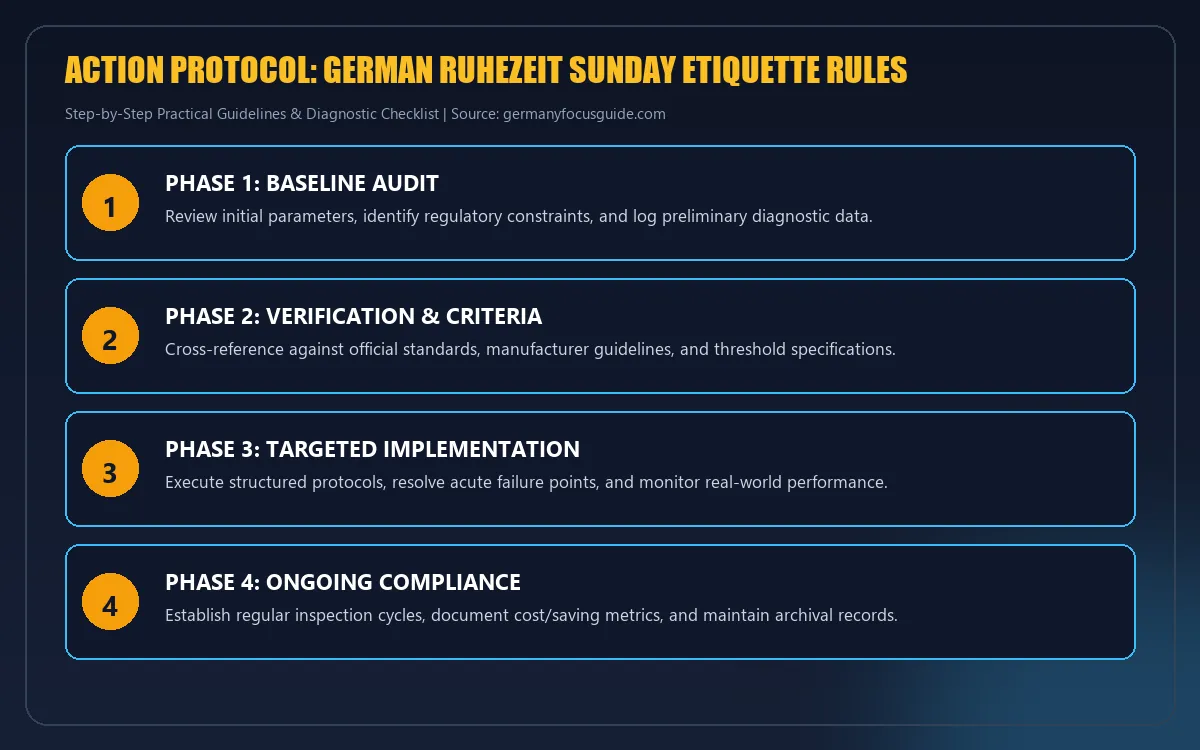
Practical Step-by-Step Implementation Protocol for Daily Compliance
Manage noise daily. Follow strict German living standards. Prevent municipal fines, landlord warnings (Abmahnung), rental termination (Kündigung). Follow systematic schedule for domestic tasks, neighbor relations, conflict mediation.
Daily Schedule Execution
Map household chores directly to legal noise bands. German rental law enforces baseline quiet: 22:00 to 06:00 or 07:00 nightly (Nachtruhe), all day Sunday, federal holidays (Sonn- und Feiertagsruhe). Many house rules (Hausordnung) add midday rest (Mittagsruhe), usually 13:00 to 15:00.
- Morning Block (07:00 – 13:00, Monday through Saturday): Execute heavy domestic chores. Run laundry, vacuum floors, operate dishwashers, practice musical instruments. Drilling, hammering, structural assembly permitted under regional work-noise ordinances.
- Midday Window (13:00 – 15:00, Monday through Saturday): Cease impact acoustics. Turn off power tools, stop vacuuming, lower audio devices to room volume (Zimmerlautstärke). Zimmerlautstärke requires sound remain undetectable outside closed apartment door, typically below 35 to 40 dB(A).
- Afternoon Block (15:00 – 20:00, Monday through Saturday): Resume standard domestic activities. Finalize garden maintenance, structural drilling, loud hobbies.
- Pre-Quiet Buffer (20:00 – 22:00, Monday through Saturday): Stop heavy tools. Transition machine cycles down. 32. BImSchV prohibit lawnmowers, leaf blowers after 20:00 in residential zones.
- Night Period (22:00 – 06:00/07:00, Daily): Absolute Nachtruhe. Cease all acoustic emissions exceeding ambient indoor limits. Run no un-isolated spin cycles, host no loud gatherings, play no acoustic instruments.
- Sunday and Holiday Protocol (All Day): Total quiet mandatory under state immission acts (Landes-Immissionsschutzgesetze). Vacuuming, power tool usage, bottle recycling deposit into public street containers, exterior mechanical maintenance illegal. Understand core german ruhezeit sunday etiquette rules to avoid direct confrontation with local block residents.
Laundry and Appliance Planning
Washing machines generate significant mechanical vibrations, especially spin cycles hitting 1,200 to 1,600 RPM. Mitigate impact transmission:
[Concrete Subfloor]
       ▲
[Anti-Vibration Rubber Mat (minimum 15mm)]
       ▲
[Washing Machine Feet (Calibrated Level)]
       ▲
[Appliance Cycle End Time ≤ 21:30]
Run cycles early. Program delayed starts to terminate by 21:30. Modern appliances under 50 dB(A) legally permitted overnight if vibration-isolated. Old machines in buildings with wooden-beam ceilings (Altbau) breach Zimmerlautstärke automatically. Never run non-decoupled wash cycles on Sundays.
Neighbor Pre-Notification Protocol
Planned events (unavoidable late arrivals, family celebrations, scheduled maintenance) require early written notice. Notification does not alter legal quiet hours, but builds goodwill and prevents police calls.
Post notice on building bulletin board (Schwarzes Brett) or deliver individual slips minimum 48 hours prior. Use standard structured text:
Liebe Nachbarn,

am Samstag, den [Datum], feiere ich meinen Geburtstag im kleinen Kreis /
führe ich notwendige Renovierungsarbeiten durch.

Ich bemühe mich, den Lärmpegel so gering wie möglich zu halten.
Ab 22:00 Uhr verlegen wir die Feier nach drinnen und reduzieren die Lautstärke.

Sollte es dennoch einmal zu laut werden, bitte sprechen Sie mich
direkt unter [Telefonnummer / Apartment-Nummer] an.

Vielen Dank für Ihr Verständnis!
[Ihr Name], Top [Wohnungsnummer]
Escalation and Mediation Workflow
Follow precise procedural chain when neighbor breaches quiet hours. Do not jump immediately to emergency lines.
- In-Person Dialogue: Approach neighbor at time of infraction. State issue objectively: "The bass is vibrating through the shared floor." Request immediate volume decrease.
- Written Documentation (Lärmtagebuch): If infractions recur, maintain meticulous noise log. Record exact parameters:
- Date and precise timestamp (start and end).
- Type of noise (subwoofer, mechanical hammer, dog barking).
- Perceived intensity and room affected.
- Independent witnesses (other tenants, visitors).
- Landlord Notification (Mängelanzeige): Forward Lärmtagebuch to building property manager (Hausverwaltung) or landlord. Demand landlord restore contractually guaranteed quiet (Mängelbeseitigung). Request rent reduction (Mietminderung) warning under § 536 BGB if landlord acts slowly.
- Non-Emergency Law Enforcement: Call local municipal regulatory office (Ordnungsamt) during standard business hours, or local police precinct non-emergency phone number during late-night violations. Police units enter premises, issue formal cease warnings, seize audio hardware under repeated non-compliance.
Diagnostic Considerations, Edge Cases & Common Pitfalls
Tenant disputes often hinge on edge cases where standard quiet hours interact with federal statutory exemptions, bodily functions, and property maintenance necessities.
Child Noise Protections (§ 22 Abs. 1a BImSchG)
German Federal Immission Control Act provides near-absolute protection for child-induced noise (Kinderlärm):
- § 22 Abs. 1a BImSchG mandates sounds from children’s daycare facilities, playgrounds, similar installations not considered harmful environmental impact (schädliche Umwelteinwirkung).
- Principle applies fully to residential rentals. Crying infants, toddler footfalls, developmental outbursts exempt from Ruhezeit restrictions.
- Landlords cannot issue Abmahnung for crying babies; courts consistently reject neighbor noise complaints for natural child actions (BGH, Az. VIII ZR 226/09).
- Limit exists: Nighttime indoor soccer, roller-skating, deliberate destructive behavior late at night remain non-protected; parents must exercise reasonable supervision (Aufsichtspflicht).
Nighttime Hygiene and Bathing Rights
Old rental contracts often contain clauses banning showers or baths past 22:00. Federal court rulings override these clauses entirely:
- Personal hygiene constitutes basic human need protected under general personality rights (Art. 2 Abs. 1 GG).
- Landlords cannot prohibit late-night showers or baths (OLG Düsseldorf, Az. 5 Ss (OWi) 411/90).
- Legally enforced boundary: Bathing time, including water filling and draining, limited to maximum 30 continuous minutes between 22:00 and 06:00.
- Running pipe acoustics must remain within technical DIN 4109 limits (building soundproofing standard).
Emergency Repairs vs. Prohibited DIY Maintenance
Distinguish sharply between emergency mitigation and regular property maintenance:
| Intervention Type | Examples | Sunday / Night Authorization | Legal Justification |
|---|---|---|---|
| Active Emergency | Burst pipe, sewer backup, structural roof leak, total heating failure during frost. | Authorized instantly. Police or municipal authorities cannot penalize emergency interventions. | Notstand (§ 228 BGB / § 904 BGB); landlord obligation to prevent structural loss. |
| Urgent Professional Repair | Gas leak isolation, electrical short remediation, professional drain routing. | Authorized with licensed tradesmen (Notdienst). | Imminent danger prevention (Gefahr im Verzug). |
| Prohibited DIY Maintenance | Assembling flat-pack furniture, hanging art, wall drilling, tile cutting, sanding. | Prohibited during all Ruhezeiten (nights, Sundays, holidays). | Non-urgent domestic activity; zero statutory exemption. |
Violations of DIY boundaries on Sundays breach § 117 OWiG (inadmissible noise generation), risking immediate municipal intervention.
Domestic Pet Acoustic Thresholds
Occasional pet noise acceptable; sustained acoustic disturbance breaches residential tenancy contracts:
- Dog barking legally categorized as intermittent vs. persistent.
- Accepted baseline: Intermittent barking upon doorbell ring or brief stimulus (1 to 2 minutes).
- Unacceptable baseline: Continuous barking exceeding 10 consecutive minutes, or cumulative barking exceeding 30 minutes across entire day (OLG Hamm, Az. 22 U 249/89).
- Night hours: Absolute quiet applies to animals. Persistent whining, howling, or running on non-insulated laminate floors during Nachtruhe justifies rent reductions and civil lawsuits under § 1004 BGB.
Regulatory and Relocation Compliance Across Jurisdictions
International arrivals living in German rental units often encounter strict rules suddenly. Review entry authorizations, visa compliance, and consular requirements via the Official European Commission ETIAS Portal, check the codification of stay terms in the Schengen Borders Code (Regulation EU 2016/399), and cross-reference personal residency responsibilities via the U.S. Department of State Germany Travel Advisory.
Ordnungsamt Reporting Risks and Malicious Calls
Calling law enforcement requires legitimate cause. Misuse carries civil and penal risks:
- False police reporting (Vortäuschen einer Straftat, § 145d StGB) or deliberate false accusations (Falsche Verdächtigung, § 164 StGB) trigger criminal prosecution.
- Habitual, unfounded calls to Ordnungsamt targeting specific neighbors constitute harassment (Nachstellung, § 238 StGB).
- Municipalities assess administrative deployment fees (Gebührenbescheid) against malicious callers if response teams register zero audible disturbance upon arrival.
Frequently Asked Questions
Can I mow my lawn on Sunday if I use an electric or robotic lawnmower?
No. The 32. Verordnung zur Durchführung des Bundes-Immissionsschutzgesetzes (Geräte- und Maschinenlärmschutzverordnung) bars lawnmower use in residential, recreation, and health zones all day Sunday and on public holidays. This federal ban covers combustion-engine, standard electric, and robotic lawnmowers regardless of individual decibel output. Standard push-mowers without motors are legal if sound stays within Zimmerlautstärke. Violations trigger administrative citations up to €50,000 under § 62 BImSchG, though first-time municipal fines typically land between €50 and €400.
Is it legally permissible to run a washing machine or dishwasher after 22:00?
Yes, with acoustic limitations. The Federal Court of Justice (BGH) recognizes running modern washing machines and dishwashers as customary living practice (sozialadäquate Lebensführung). Shift workers must wash clothes during off-hours. Modern appliances must not breach baseline Zimmerlautstärke rules inside neighboring living spaces. High-speed spin cycles on non-isolated subfloors transfer vibrations through shared walls, violating Nachtruhe. Set appliances on thick anti-vibration mats, use eco-modes that limit pump and motor whines, and conclude cycles before 22:00 whenever possible.
What specific steps should I take if my neighbor habitually ignores quiet hours?
Execute a four-stage escalation process. First, approach neighbor politely during daytime hours; confirm they realize noise penetrates shared structures. Second, record every infraction for two to four continuous weeks in a written Lärmtagebuch, logging date, exact time, sound type, perceived volume, and corroborating witnesses. Third, file a formal complaint (Mängelanzeige) with your landlord or Hausverwaltung, submit the log, and demand action with a 14-day cure window. Fourth, contact police or the municipal Ordnungsamt while excessive noise occurs between 22:00 and 06:00 or all day Sunday, securing an official law-enforcement event record.
How high are the fines for violating German quiet hours?
Statutory limits depend on legal code and infraction severity. For basic noise disturbance under § 117 of the Act on Regulatory Offences (OWiG), local municipal offices (Ordnungsamt) levy fines up to €5,000. For equipment rule breaches under the Federal Immission Control Act (such as Sunday power tool or heavy machinery operation), fines range up to €50,000. Municipal authorities calibrate initial penalties based on severity, noise duration, and past infractions. First offenses cost between €35 and €150. Repeated offenses cost €300 to €1,000, alongside administrative fees.
References
- Gesetz zum Schutz vor schädlichen Umwelteinwirkungen durch Luftverunreinigungen, Geräusche, Erschütterungen und ähnliche Vorgänge (Bundes-Immissionsschutzgesetz – BImSchG), § 22 Abs. 1a.
URL: https://www.gesetze-im-internet.de/bimschg/__22.html - Zweiunddreißigste Verordnung zur Durchführung des Bundes-Immissionsschutzgesetzes (Geräte- und Maschinenlärmschutzverordnung – 32. BImSchV), Anhang zu § 7.
URL: https://www.gesetze-im-internet.de/bimschv_32/ - Gesetz über Ordnungswidrigkeiten (OWiG), § 117 Unzulässiger Lärm.
URL: https://www.gesetze-im-internet.de/owig_1968/__117.html - Bürgerliches Gesetzbuch (BGB), § 536 Mietminderung bei Sach- und Rechtsmängeln.
URL: https://www.gesetze-im-internet.de/bgb/__536.html - Bundesgerichtshof (BGH), Urteil vom 22. August 2009, Az. VIII ZR 226/09 (Kinderlärm in Mietwohnungen).
URL: https://juris.bundesgerichtshof.de/ - Oberlandesgericht (OLG) Düsseldorf, Beschluss vom 25. April 1990, Az. 5 Ss (OWi) 411/90 (Nächtliches Baden und Duschen).
- Official European Commission ETIAS Portal, Regulation (EU) 2018/1240.
URL: https://travel-europe.europa.eu/etias_en - Schengen Borders Code, Regulation (EU) 2016/399, Official Journal of the European Union.
URL: https://eur-lex.europa.eu/eli/reg/2016/399/oj - U.S. Department of State, Bureau of Consular Affairs, Germany International Travel Information.
URL: https://travel.state.gov/content/travel/en/international-travel/International-Travel-Country-Information-Pages/Germany.html